
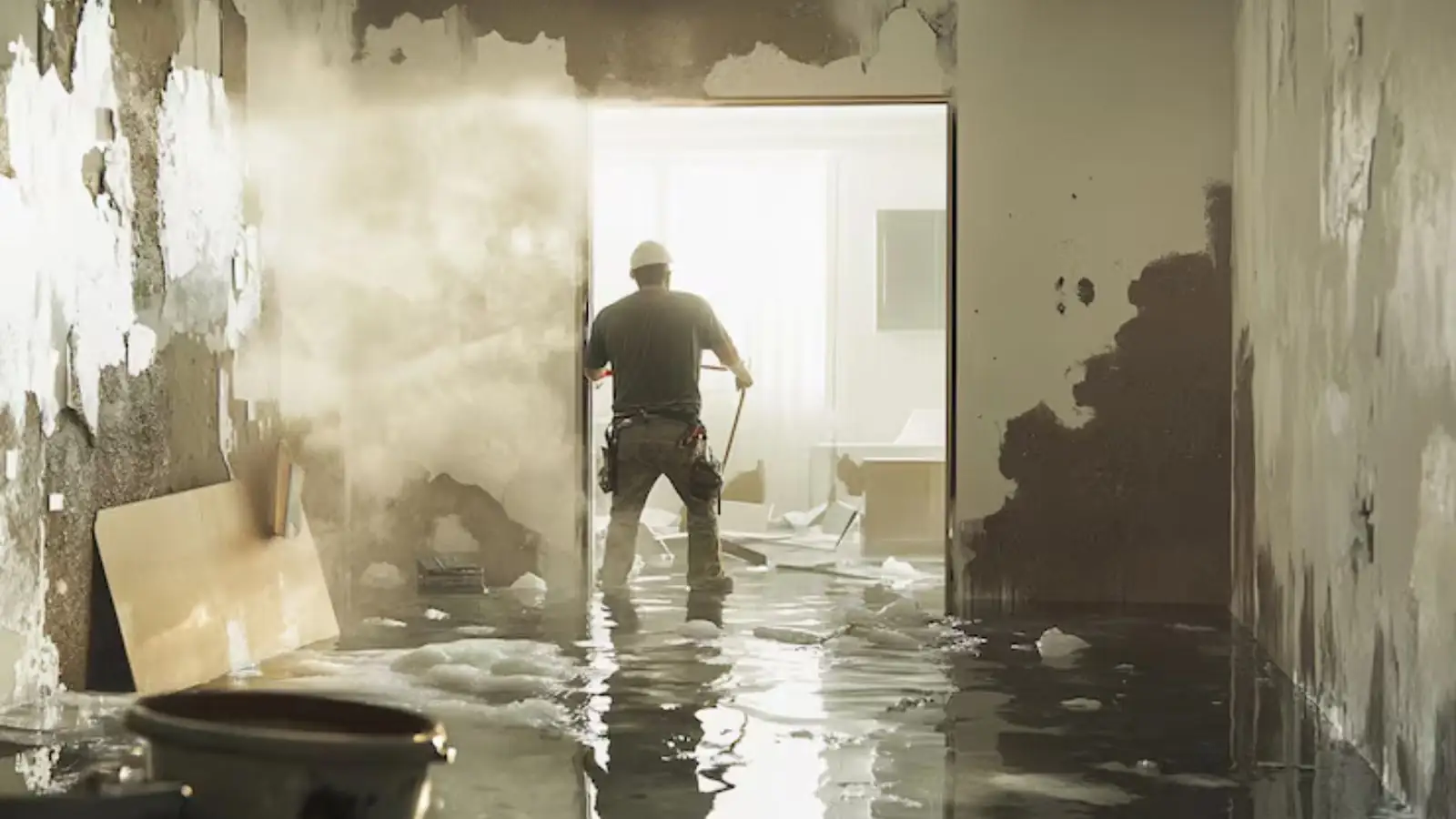
Drywall water damage repair in Mission Hills, CA depends on one question, which is how long the board was wet. Drywall is gypsum between sheets of paper, and it behaves differently at each stage of wetness. A quick wipe-down and a month of dampness lead to different repairs.
This guide covers how to judge whether drywall can stay, how to cut and replace it and what to do about the framing and insulation behind it. It assumes the water source is fixed. If it is not, stop and deal with that first.
Can the drywall be saved?
| Condition | Likely outcome | Why |
|---|---|---|
| Wet briefly with clean water, firm, quickly dried | Often saved | Gypsum has not broken down |
| Stained, firm and dry | Often saved with primer and paint | Cosmetic only |
| Soft, crumbly or bulging | Replace | Gypsum has lost strength |
| Wet with contaminated water | Replace | Porous material holds contaminants |
| Moldy paper facing | Replace | Growth extends into the board |
Press gently with your thumb. Firm board that returns to shape is a good sign, and a dent that stays is a bad one. A moisture meter gives numbers, and a thermal camera shows wet areas you cannot see.
The flood cut and why it exists
When a wall is wet from the bottom, the usual fix is a flood cut, which means removing the lower part of the drywall, often to about 12 to 24 inches above the wet line. This opens the cavity so it can dry and lets you check insulation and framing. Cutting higher than the water line leaves clean, dry board that can be patched.
Make the cut straight and level so the new board fits. If a stud lies behind the cut line, use it as an anchor, and if not, add a backing strip. Remove wet insulation and let the cavity dry fully before closing it.
Wet drywall and unsure what to cut?
Call the line. A technician can explain how moisture readings guide the cut line.
Hang, tape and finish
- Measure and cut new drywall to match the opening.
- Screw it to studs, with the heads just below the surface.
- Tape seams with paper or mesh tape and joint compound.
- Apply two or three thin coats, sanding between them.
- Prime and paint the whole wall for a even look.
Patience is the main skill. Thin coats dry faster and sand more cleanly than thick ones. Skipping primer leaves flat spots in the paint.
Check the framing and insulation
Wet wood framing should dry fully before being closed in. A moisture meter shows when the wood is back to a normal level. Fiberglass insulation that was wet should be replaced, and spray foam or rigid foam needs a professional assessment.
If you see mold on framing, stop and read about mold remediation. If the wet wall is part of a larger loss, the water mitigation page explains structural drying. The rebuild itself follows the water damage repair process.
Using a moisture meter on drywall
Moisture meters read a number that shows how wet a material is. Pin meters poke into the surface, and pinless meters scan without a hole. Take readings in several places, including a dry wall of the same material as a reference.
Compare the wet area to the reference, not to a printed chart alone. A wall that reads close to the reference is likely dry. If readings stay high after a few days of drying, something is still feeding it, and it is time to check for a hidden leak.
Mistakes that cause callbacks
- Closing the wall before the cavity is dry.
- Using a thin coat of paint over a stained patch without primer.
- Leaving wet insulation in place.
- Cutting only to the visible stain and missing the wet area behind it.
- Skipping the mold check on older damage.
Each of these is easy to avoid with patience and a meter. The cost of waiting a day is small, and the cost of redoing a wall is large.
Matching texture and paint after the repair
A new patch rarely matches the old wall by itself. Smooth walls blend easily, while knockdown and orange peel textures need sprayed or hand-applied texture and practice. Paint the whole wall from corner to corner so the sheen and color look even.
When to bring in a professional
Large wet areas, contaminated water, wiring in the wall and any sign of mold are good reasons to call a professional. The crew can dry the cavity, document readings and rebuild with a clear scope. A small patch from a single event is a fair do-it-yourself project if the wall is dry.
If you have doubts about how far the water went, ask for a moisture inspection. It costs less than guessing wrong and tearing out more than needed, or less than needed and finding mold later.
Checking whether drywall can stay
Press the wall with a flat hand. Drywall that feels firm, has no bubbles and has dried quickly can often be kept. Soft, crumbling or bulging sections, and walls that stayed wet for days, usually come out.
A moisture meter gives a clearer answer than touch, especially behind paint or tile. Cutting a small inspection hole is better than guessing, because wet insulation inside the wall keeps the problem alive.
When drywall does come out, a clean cut a couple of inches above the visible wet line is common, and sometimes the whole sheet goes. Baseboards can often be saved if they are pulled off carefully and dried. Let the cavity dry fully before new board goes in, because closing a wet wall only moves the problem out of sight.
The industry reference for water loss work is ANSI/IICRC S500, the Standard for Professional Water Damage Restoration. It describes water categories, drying goals and how to document readings. Citing it here is not a claim about any certificate. It simply gives you a published benchmark to ask a company about.
Local note: older walls and shared buildings in Mission Hills
Mission Hills is part of the City of Los Angeles, and rebuild permits go through the Los Angeles Department of Building and Safety. Permit rules vary by what work is done, and cosmetic drywall patching differs from changing plumbing or electrical inside the wall.
Sepulveda Boulevard is the main commercial road in the community, and shared walls in strip buildings make a leak in one unit a problem for another. If you manage or rent in such a building, notify the owner in writing and photograph the damage with dates.
Source type: City department guidance, encyclopedic neighborhood summary
Drywall water damage questions
How high do I cut drywall after a leak in Mission Hills?
Cut above the wet line, based on moisture readings, so you remove all wet board and leave dry board in place.
Can wet drywall dry in place?
Sometimes, if the water was clean, the board is firm and drying starts quickly. Soft or contaminated board should be replaced.
What if the drywall is behind cabinets or tile?
A technician can use moisture meters and a thermal camera to check without removing everything first.
Neighbors share these issues, and the San Fernando page and the Panorama City page explain local building situations.