
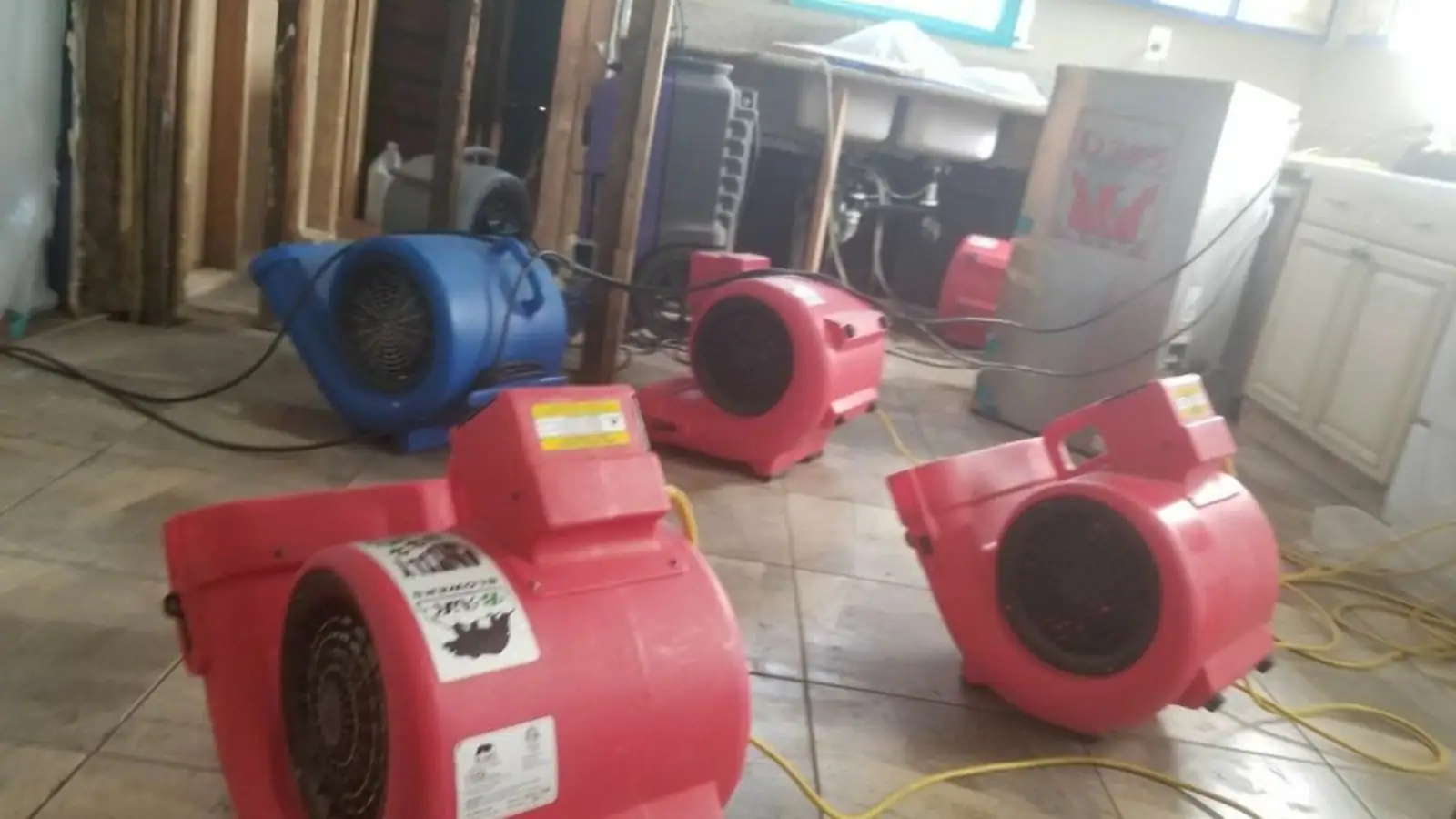
Choosing a water damage drying company in Mission Hills, CA matters more than most people expect, because drying is the stage that decides whether a house is saved or torn out. A company that sets up the wrong equipment, skips readings or leaves too early can leave moisture inside a wall. This guide explains what a good drying job looks like and what to ask.
The drying stage is also called mitigation. It follows extraction and comes before repair. You can read more about it on the water mitigation page.
What a good drying job looks like
- A moisture map made on the first visit, with readings recorded.
- Equipment matched to the size of the wet area, not a generic set.
- Air movers and dehumidifiers placed with a plan.
- Daily or regular checks, with readings compared to a dry reference.
- Equipment removed when readings reach dry targets, not by calendar.
- A written record of the readings for you and your insurer.
The key is measurement. Drying that is judged by touch or by days alone leaves hidden moisture. A company that shows you the numbers is a company that can prove the work.
Questions to ask before you hire
| Question | Good sign | Warning sign |
|---|---|---|
| How will you map moisture? | Meters and a thermal camera, with readings recorded | We will see how it feels |
| What equipment will you use? | Specific, such as air movers and LGR dehumidifiers | A vague, generic answer |
| How do you know when it is dry? | Readings match a dry reference | After a set number of days regardless |
| Will I see the readings? | Yes, in writing | They are for our records |
| How is the price built? | Explained before work starts | A number with no scope |
Want the drying plan explained?
Call the line. A technician can explain the equipment, the readings and how the price is built.
Equipment you should expect to see
Air movers push air across wet surfaces and speed evaporation. LGR dehumidifiers remove moisture from the air, and desiccant dehumidifiers are used in some cases. Moisture meters measure wood, drywall and concrete, and thermal cameras show temperature differences that hint at hidden moisture.
Ask how many pieces of equipment will be used and why. A single air mover in a large wet area will not dry it, and too much equipment adds cost. A technician should be able to explain the choice in plain words.
Red flags in a drying quote
- A promise to finish in a set number of days regardless of readings.
- No mention of moisture readings or documentation.
- No plan for contents, flooring or wall cavities.
- Pressure to start immediately without explaining the scope.
- A quote that includes demolition with no moisture reasoning.
Beware promises that sound too good. Drying depends on the materials, the amount of water and the conditions in the home. An honest company explains that, and it gives you an estimate after the first assessment.
A typical example: kitchen supply line leak
A supply line under a kitchen sink fails overnight and soaks the cabinet, the floor and the wall behind. The technician maps moisture, removes the cabinet toe kick and a strip of wall base, and extracts water from the flooring. Air movers and a dehumidifier run in the kitchen, with readings taken daily.
On the third day, the wall and the subfloor read dry, and the equipment is removed. The same readings go to the insurer, and the rebuild begins with new base, trim and paint. In this example, drying was finished by measurement, and the repair did not start until it was.
What to expect each day of drying
Day one is extraction, moisture mapping and equipment setup. Following days are check-ins, where the technician records readings and adjusts equipment. You may notice noise and warmth from the dehumidifiers, and electricity use will rise.
Ask what the company expects to see by each visit, and ask to be told if readings are not falling. A flat reading is a clue that something is feeding the moisture, and it deserves attention instead of another day of the same plan.
Questions about documentation and your insurer
Ask whether the company will provide moisture logs, photos and a written scope, and in what format. Your insurer may want them, and so may a landlord or property manager. A company that already keeps those records makes the claim conversation easier.
How to compare two drying quotes
Put them side by side and compare equipment, days, readings and what is included. A lower quote with fewer pieces of equipment may take longer or leave moisture behind. A higher quote with clear documentation may be the better value.
Ask each company to explain the first day. Specifics show planning. Vague answers show guesses, and guesses cost more in the end.
What daily drying records should look like
A good drying job leaves a paper trail. Expect a log of moisture readings taken on each visit, showing the numbers falling toward the dry standard for each material. The log also lists the equipment placed and when it was removed.
Ask to see the readings on each visit. If the numbers stall, the crew should change the setup instead of waiting. Those records are also what many insurers ask for.
Ask what happens if a material does not dry as expected. A thoughtful company will describe how it adjusts airflow, extraction or removal instead of simply leaving equipment running for days. Clear answers to these questions say more than any claim on a flyer.
Local note: checking a company in Mission Hills
The Contractors State License Board is the California agency that handles contractor licensing, and you can ask any company about its licensing and look it up. Our own site does not list license numbers, and you should verify any provider you hire independently.
Mission Hills water comes from the Los Angeles Department of Water and Power. If the loss began with a main break, as the Woodman Avenue break in 2019 did, tell the company so the crew plans for outside water entry. For permits tied to a rebuild, ask the Los Angeles Department of Building and Safety.
Source type: State agency, city utility, utility-statement reporting, city department guidance
Drying company questions
How can I tell a company is really drying and not just running fans in Mission Hills?
Ask for moisture readings at the start and each visit. A company that is drying will show the numbers falling.
Do I need a company that also does repairs?
It can simplify scheduling, but it is not required. Ask whether rebuild is included or quoted separately.
Should I rent equipment and dry it myself?
That is not something we offer. Placement and measurement matter, and a technician provides both.
If you live nearby, see the Granada Hills page and the San Fernando page for local details. The emergency water removal page explains what happens before drying starts.